
Newsletter Subscribe
Enter your email address below and subscribe to our newsletter
Enter your email address below and subscribe to our newsletter

your universe of games, movies & tech
After One Battle After Another I did the one thing every director with ambitions of a “big political statement” secretly dreads: I went straight to Google and typed “One Battle After Another ending explained.” Not because I’m incapable of following complex cinema, but because somewhere between migrant limbo, revolutionary cosplay and inter-racial desire, the film swung so violently off the rails that I genuinely needed to check: is it me, or is it the movie?
On a formal level, One Battle After Another sits in that rare space between festival indie and edge-of-your-seat studio spectacle. It’s loosely inspired by Thomas Pynchon’s novel Vineland, and you can feel that lineage: the cat-and-mouse games, the paranoid officials, the ghosts of failed revolutions trailing behind every joke. It’s three hours that genuinely feel like one, not because the film is flawless, but because it never stops throwing something at you — an idea, a gag, a punch or a bad decision.
And here’s the twist: I still think it’s worth seeing at least once. For the cast. For the controlled insanity. For the humour that occasionally hits frighteningly close to home. For the music and colour grading that make the screen look almost radioactive. But let’s unpack it properly.

The weakest part of One Battle After Another is the way it tells its story. Not the premise itself, but the narrative delivery.
If you’re not already plugged into the brutal reality of US migration politics — both from the perspective of the state and the migrants it tries to contain — the first thirty minutes will feel like being dropped into the middle of a riot with no map and no explanation.
Revolutionary cells, migrant caravans, armed militias, raids, jailbreaks, skirmishes — the film throws all of this at you without offering a stable point of entry. There’s barely any exposition, very little grounding, and no clear sense of who is who or why they’re doing what they’re doing. It’s like starting a series from episode four and being told to “just catch up”.
Trying to recount the plot beat by beat is about as meaningful as describing every stunt in a late-era Fast & Furious: yes, things explode, people shout, someone fights for something. But the film is much less about “what happens” and far more about the emotional and visual chaos of how it happens. And that “how” is deliberately, sometimes aggressively disorienting.
My biggest gripe lies with the characters’ motivations — or rather, their absence.
He is a soft-edged, slightly pathetic boomer-revolutionary, clinging to a fantasy of lost youth through fireworks and improvised explosives. Leonardo DiCaprio leans into the bumbling, cowardly persona he’s been circling in recent years, and he does it very well; he’s funny, infuriating, and oddly human.

She is a vulgar Amazon with surgically carved cheekbones, a figure who looks like she walked straight out of a music video and into a war zone. Teyana Taylor is hypnotic to watch — not because the script gives her depth, but because her mere presence is electric.
The third point in this deranged triangle is a soldier with a worn, almost cracked face and the permanently anxious gaze of a young man who has seen more than his nervous system can handle. Casting Sean Penn here borders on genius: every time he appears, you instinctively want to throw something at the screen. That’s not a bug, that’s the performance working exactly as intended.
The problem is what isn’t there. We barely get a sense of who these people were before the revolution, what specifically pushed them into this conflict, what private wounds they carry. I have very little patience for the “I rob because I rob” school of character writing. When there’s no biography, the madness feels random rather than inevitable.
The women suffer the most from this. They are impeccably framed, stunning, magnetic — and nearly hollow on the page. Beautiful shells with minimal interior architecture. It has strong Little Prince energy: we’re told the rose is important, but behind her is mostly air.
The opening act plays like a fever dream stitched together out of border-patrol news footage and very strange adult content.

The migration theme keeps surfacing — detention buses, barbed wire, desert crossings — but it’s constantly intertwined with erotic tension and stylised violence. At some point it genuinely begins to feel as if the director fell down a rabbit hole of “interracial” porn and decided this is now a valid metaphor for American power dynamics.

It’s darkly funny, but also exhausting. You sit there trying to build even a skeleton of coherent narrative logic, and the film keeps shrugging off your attempts, as if clarity itself is a form of betrayal.
The second major issue is the film’s very obvious flirtation with Tarantino.
The saturated colour palette, the bursts of surrealism, the oddball dialogue, the choreographed bloodshed — all of it nods toward Pulp Fiction and its descendants. But where Tarantino thrives on maximalism — if there’s blood, it’s a flood; if there’s romance, it’s a death pact — One Battle After Another often stops halfway up the ladder.
The film wants the swagger of Tarantino, the wink-to-camera bravado, but doesn’t fully commit to that operatic level of hyperbole. The result feels less like a confident homage and more like a slightly blurred imitation. You sense you’ve been invited onto a wild genre ride, but the operator never quite turns the speed up to “insane”.
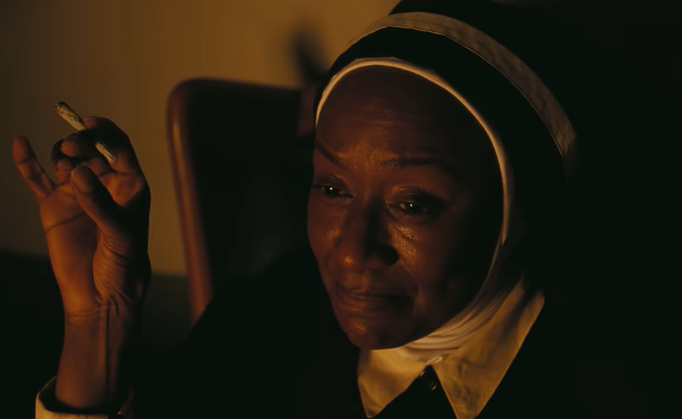
Despite all the guns, slogans and flags, One Battle After Another is not some pure, razor-sharp political manifesto. It’s not a final verdict on American fascism, not an exhaustive satire on Trumpism, and not the film that will redefine how we talk about migration.
Like most smart directors, the filmmaker is using the political climate as high-octane fuel rather than as the final destination. The role of mainstream cinema in “shaping reality” is very overrated — most of the time it’s echo, not engine.
This is where the title does a lot of heavy lifting. One Battle After Another isn’t just about the series of clashes we see onscreen. It’s about the feeling that history itself has jammed on a loop: one skirmish, one outrage, one uprising after another, with no real resolution.
On one side we have radicals who loathe capitalist, xenophobic America and, in the bravura opening, liberate a bus full of migrants from a mobile prison on the Mexican border. On the other side we have militarised guardians of order whose violence escalates with every new act of resistance.

The film clearly sympathises with the losers of this war, but it doesn’t canonise them. At the same time, it steadfastly refuses to grant moral victory to the conservatives dreaming of a “strong” totalitarian stability. We end not with a winner, but with a stalemate — a permanent emergency in which two incompatible visions of utopia face each other across a battlefield that never fully clears.
One unexpectedly interesting side effect of One Battle After Another is how it reframes Ari Aster’s work.
Where Aster and Joaquin Phoenix drill into the raw, psychological nerve of modern anxiety, One Battle After Another feels more like a comic-book rendering of that same turmoil. Aster doesn’t show us reality or its glossy superhero version; he shows us the mental feed — the doomscrolling nightmare our brains generate when the world outside gets too loud.
Against that backdrop, DiCaprio’s chilled, half-clueless revolutionary starts to look almost cartoonish. And that contrast is useful. It underlines how different filmmakers choose to talk about the same underlying crisis: Aster through intimate psychological horror, this film through grandstanding, grotesque spectacle.
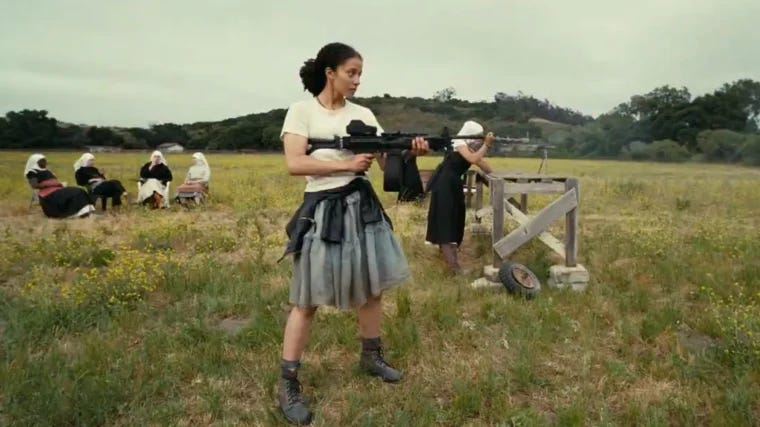
By the time One Battle After Another reaches its own body-horror flourishes, there is a strange tenderness in the way it reminds us that every villain, every ideologue, every icon of power is still stuck in the same fragile flesh. It’s a grim kind of comfort, but a comfort nonetheless.
Yes — with caveats.
You should probably see One Battle After Another at least once if you:
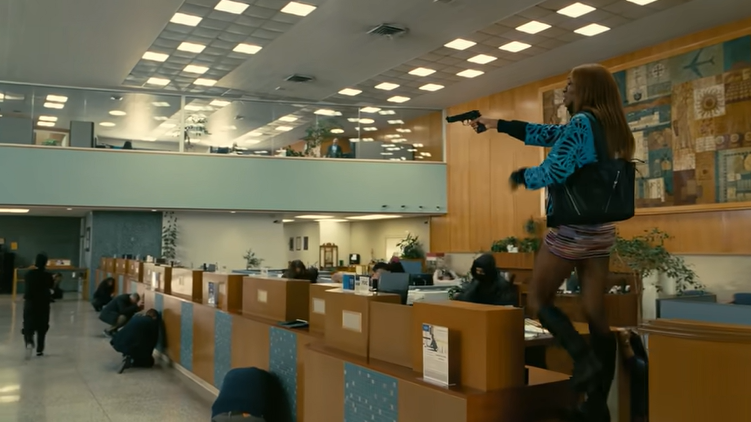
You should probably temper expectations if you:
For me, One Battle After Another is not the kind of film I’ll revisit every year. But inside all that noise and narrative chaos, there is something disarmingly honest — a portrait of a world stuck in permanent conflict, lurching from one clash to the next without ever really knowing what “victory” is supposed to look like.
By the time the credits roll, the title feels almost brutally literal. This isn’t a “yay, the good guys saved the day” story; nothing is neatly fixed, no system actually collapses. The fight between radicals and the state is shown as a grinding, uphill struggle that simply passes from one generation to the next.
As Bob ages out of the fight and retreats into the anxious, compromised role of father, his daughter drifts toward the same revolutionary tide that once carried him. She inherits the battle, but not the promise of a result.
One battle after another — and still no guarantee there’s anything like a summit waiting at the top.


